
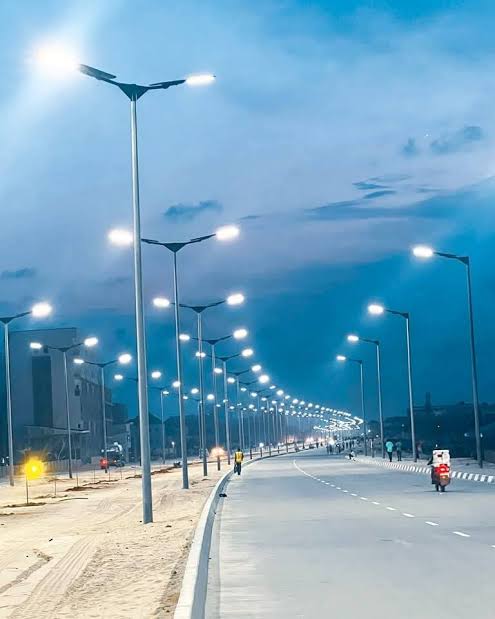
Debacle wasn’t my first choice of terms for the Lagos-Calabar coastal road/highway, LCCR/H for short. Scam was, and others have called it a fraud on national television. Quite a dangerous assertion to make but I will make it to save Nigerians from leaders who want to take them for a ride. I will play the role of the boy who told the admiring crowd that the emperor was naked. I believe we are familiar with the story.
This time President Tinubu golden robe is the L-C-C-R or H. Seen as Tinubu’s can-do audacity, bragging rights and will be legacy whenever the project is completed. At current rate of construction of thirty kilometers per year or 120 kilometers in four years, completion would be in another twenty years’ time, also considering that current construction is ongoing in the easier terrain these four years. The question is can the 700-to-750-kilometre Highway be completed at all? Most improbable for the following reasons.
If the highway is to fit the description of being a coastal road, 450-500 kilometers of the highway will traverse the world’s third largest mangrove and Africa’s largest. In addition, another 150 kilometers of swampy water-logged terrain begin before Epe to the estuary of Benin river where real mangrove vegetation begins and continues unbroken to Calabar. Meaning over 600 kilometers stretch of both subsurface and surface water terrain. This has to be traversed by raised viaducts and bridges similar to the long bridge along Lagos Ibadan express road. This time 600 kilometers of viaducts and bridges not the ten kilometers long bridge on Lagos Ibadan express. Some of the bridges must be raised so high as to allow ships take cargo up some rivers to inland river ports. Complications galore.
That is not all. To make the task harder, bridges spanning over half a kilometer have to be built over several estuaries of the Niger Delta and several rivers emptying into the Atlantic Ocean, about thirty of them at last count. The enormity of the proposed LCCH is in plain sight but we Nigerians have blinkers over our eyes. Familiar to anyone who has journeyed from Lagos to Epe is the single lane bridge/viaduct before the bridge over Lekki lagoon just before Epe. These two, viaduct and bridge, are examples of what is needed to have a coastal road. Before the Epe, we have the Dangote Refinery having piling and sand filling of the entire site. Imagine doing this along six hundred kilometers!
This endeavor though not impossible, is highly improbable. On searching for such gargantuan construction through other mangroves around the world, I found two. The one-hundred-year-old Tamiami Trail along Florida Coast in United States built inadvisably between 1915 and 1920s with no regard for marine life, no environmental impact assessment. This has required expensive correction like a $500 million dollar bridges spanning just 16 kilometers to restore part of the mangrove that had been destroyed. The Florida coastal road through mangrove is just 120 kilometers.
Brazil has also built through mangrove for distance of about 800 kilometers. Built over twenty years from the 1950s to 1970s on sand filled embarkments throughout, with no EIA again destroying Marine life. This is 2026 and Nigeria will not have the luxury of disregarding mangrove marine life. Recent construction through mangroves has occurred in Indonesia and Vietnam but at a lower dimension of less than 50 kilometers. The LCCH would be first of its kind to span over 500 kilometers with bridges, tunnels, culverts and viaducts to preserve mangrove/marine life. The vaunted blue economy of Nigeria also promises to protect marine life.
Obviously, the Victoria Island to before Dangote industrial sites is the easiest part of the construction put at around $5 million dollars per kilometer. Beyond that site with examples from other parts of the world, construction cost balloons to anywhere between $20 million and $80 million dollars per kilometer! The financial implications for the whole 700 kilometers is enough to end this discussion but let us pretend Nigeria is financially capable and allow other transportation economic assessment.
Does the traffic from Lagos to Calabar, both human and cargo, warrant expending a sizable portion of government revenue on the highway? What is this traffic compared to the traffic on the existing East West Road that go through Benin-Asaba-Onitsha on to Calabar. Going through nine coastal States is no economic justification as there are no cities of sizable population along the route. Warri, Sapele, Port Harcourt and Calabar are not coastal cities. To get to Warri, Sapele, Port Harcourt etc. spurs traversing difficult terrain that would have to be added to the 700 kilometers. A comprehensive financial implication of the whole project I doubt has been done. And God saves Nigeria from cost overruns making the project a forever sink hole.
The opportunity cost of the project is enormous for a cash constrained country that already spends 60% of its budget on debt interest payments. Resources and attention is being diverted from existing roads that take more traffic to various commercial locations in the North and East of the country. The Ogbomosho Ilorin Highway calls for attention. The route from southern cities to Abuja is more vital, just to name a few. To this suffering of road infrastructure all over the country, we have under funding of capital projects in the federal ministries all because of a legacy project. The same Tinubu who accused governors of building needless flyovers in their states is building a fly over from Epe to Calabar! Talking of four fingers pointing backwards.
Political damage: I have a strong intuition that the LCCH actually birthed the Sokoto Badagry Highway for political balancing rather than objective transportation economic considerations. All considerations applying to LCCH also applies to the Sokoto Badagry Highway though the outcome might be different. A political repercussion is that future presidents will have their own ill-conceived legacy projects usually located in the region the president is from. Earlier we saw it with late President Buhari’s Kano/Katsina Maradi rail line into Niger. God help us.
The environmental cost: The LCCH is a potential ecological disaster if not done appropriately. The 275-kilometer Tamiami Trail in Florida led to the destruction of its mangrove vegetation. Retrofitting is being done currently at enormous cost of half a billion dollars for a 16-kilometer viaduct to ameliorate the damage. The 800-kilometer BR 1 101 along the coast of Brazil led to flooding, pollution and loss of mangrove as well. It was built in the 1950s without environmental impact assessment. Hence the severe ecological and environmental damage that is being addressed by installing viaducts and bridges along sections of the road. Nigeria would definitely not be allowed to go through with a highway on an elevated embarkment that will form a dam along the length of the Nigerian mangrove killing it off.
Benefits and beneficiaries of the L-C-C-R/H: Lagosians and those who ply the Lekki peninsula are primary beneficiaries of the L-C-C-R/H. They might be the sole beneficiary as the current Lekki Epe Express has become inadequate for the immense traffic plying the axis. Time will tell whether relieving the Lekki Epe traffic is what birthed the L-C-C-R/H and once this is achieved, work on other segments slows down and eventually stops.
HITECH CONSTRUCTION firm the contractor, also benefits immensely considering they are the new Julius Berger of Nigerian road construction. Not a bad thing as the Chagoury brothers hold Nigerian citizenship and HITECH CONSTRUCTION firm is headquartered in Lagos Nigeria and I believe in Nigerian construction firms executing Nigerian mega projects. For all intent and purposes construction firms like Julius Berger remain largely foreign.
I have to single out Aliko Dangote as a beneficiary because logistical choke points to his investments is being relieved. His articulated vehicles will move products out easily. Of course, Lekki Deep Seaport falls into this category. Another plus for Dangote is more demand for his cement and aggregates from his massive quarry which is one of the closest to the L-C-C-R/H.
President Tinubu might in the short run be a beneficiary but as the project gets bogged down and bugged down it will, ending up a white elephant project for eternity with President Tinubu’s name on it. Lagos State government is a key beneficiary as it has gotten the federal government to execute an infrastructure that should have been executed by the state.
Way Forward: I am not anti-mega infrastructure but the Ijebu’ in me demand interrogating expenditure economically, after all economics is defined as allocating scarce resources to competing wants and needs including judicious use of government finances. President Tinubu is not the originator of having a coastal infrastructure to convey goods and passengers. He has simply belled the cat. Knowing the enormity of the task and Nigeria not being China, a country that is not daunted by such engineering, how do we proceed when the easiest part of the construction is completed? I recommend that reconsideration be given to the facility being continued as a standard gauge rail only project and avoiding the coastline and the Delta. This rail project should be 30 to 50% less capital intensive than the LCCR/H.
It can also be used to trigger Nigerian firms acquiring rail construction capabilities. Isn’t it a shame that construction of the Lagos to Kano standard gauge rail tracks has ceased at Ibadan after the Chinese firm packed and left. Nothing is new in my recommendation as the current project come with standard gauge rail tracks running in the middle. Rail should be given priority over road and need not be coastal in its entirety.